With the young unable to afford to leave home and the old at risk of isolation, more families are opting to live together
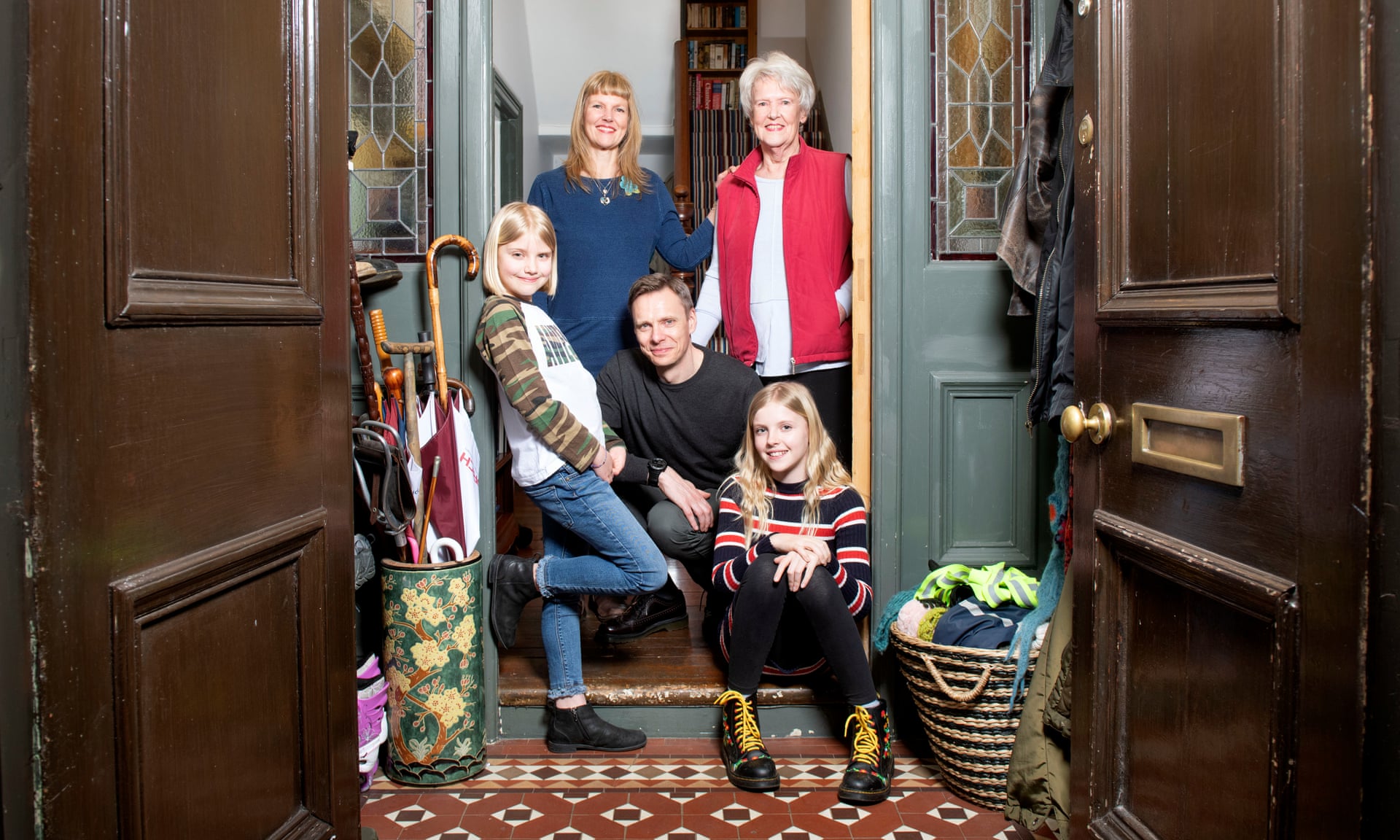
The doorway to serenity, for Nick Bright at least, leads straight to his mother-in-law: she lives on the ground floor, while he lives upstairs with his wife and their two daughters.
Four years ago they all moved into a three-storey Victorian house in Bristol – one of a growing number of multigenerational families in the UK living together under the same roof. They share a front door and a washing machine, but Rita Whitehead has her own kitchen, bathroom, bedroom and living room on the ground floor.
“We floated the idea to my mum of sharing a house,” says Kathryn Whitehead. Rita interjects: “We spoke more with Nick because I think it’s a big thing for Nick to live with his mother-in-law.”
And what does Nick think? “From my perspective, it all seems to work very well. Would I recommend it? Yes, I think I would.”
It’s hard to tell exactly how many people agree with him, but research by the Cambridge Centre for Housing and Planning Research indicates that the numbers have been rising for some time. Office for National Statistics estimates suggest that the number of households with three generations living together had risen from 325,000 in 2001 to 419,000 in 2013.
Other varieties of multigenerational family are more common. Some people live with their elderly parents; many more adult children are returning to the family home, if they ever left. The Resolution Foundation says about 20% of 25-34-year-olds live with their parents, compared with 16% in 1991. The total number of all multigenerational households in Britain is thought to be about 1.8 million.
Manisha Patel, a senior partner with PRP Architects and a design advocate for the mayor of London, wants us to see a lot more. “The idea was in my head for years because I felt there was a need, but no one would take it on,” says Patel, who has designed multigenerational housing for a new neighbourhood being built near the Olympic velodrome in Queen Elizabeth Park, east London. Other projects are in the pipeline in areas including Slough, Truro and Cambridge. “Young people can’t get on the housing ladder, so you get kids coming home, families growing who can’t afford to move. You’re getting loft conversions and extensions, and people are losing their independence. This is where the multigenerational house comes in.” Her design is for a three-storey townhouse with a separate two-storey annexe connected by a courtyard, each with their own front door – a typology in architectural jargon. “By having these new typologies, they can encourage communities to stay together. You don’t have to move away,” says Patel.

A multigenerational house, designed by PRP Architects, near the Olympic Park in east London.
Until those typologies become more widespread, most people will need to improvise. Kathryn and her family, who decided to try living together after the death of her father, were unimpressed by what they found in Bristol.
“Whenever we looked at places that had a granny annexe, it wasn’t quite right – it was up steps or at the bottom of the garden,” Kathryn says. “It needed to be Mum’s own place as well.” Eventually Nick, a photographer and lecturer in photography at the University of the West of England, and Kathryn, who teaches English as a second language, found the right place.
“At first, I didn’t quite know how to handle it if Mum was downstairs on her own watching TV,” Kathryn, 50, says. “Four years down the line we’ve worked out the programmes we like, and if Nick wants to watch Match of the Day I can saunter downstairs and watch something with Mum.” Their daughters, Betsy, 11, and Lila, nine, often head down to watch quiz shows or Strictly with their grandmother. “She’s taught them to knit and speak some Spanish and she’s told them stories of her younger days and they’re often quite silly and have fun together,” says Kathryn. For Rita, 80, the experiment works because they get on well, eat together around twice a week and help each other. “I can pick up the children from school sometimes or do the washing or the ironing,” she says. “For me it’s a big advantage to be in a house which has got noise in it. I’ve got company and I’m not on my own any more.”
Dr Gemma Burgess, acting director of the Cambridge Centre for Housing and Planning Research, has interviewed dozens of multigenerational families. “What struck us the most was the high level of trust and the absolute lack of any financial or inheritance planning, or any legal structure for their living arrangements,” Burgess says. “People had invested their life savings in a house with their grown-up children and not had their names put on the deeds: ‘Oh, we trust them – it will be all right, they’ll look after us’.”
There are potential practical upsides. A family under one roof pays one set of bills for council tax, internet, water, electricity and gas. There are also complications – it’s harder to get the best mortgage deal if more than two people are listed on the property title deeds and many companies won’t lend to people over 70 or 75.

Multigenerational housing at Chobham Manor in east London.
And while most people were happy with their choices, some felt stuck. “We interviewed a woman in her early 40s,” Burgess says. “Her husband announced one day he was moving his mother to come and live with them in a granny annexe. She moved in. They didn’t get on. And then he died, leaving this poor woman living with her mother-in-law with a clause in his will saying that she couldn’t dismantle their living arrangements.”
Stories like that are more common in parts of the world where multigenerational living is more ingrained. In India, particularly outside cities, young women are expected to move in with their husband’s family when they get married. Their position in joint families makes them more vulnerable to abuse and young married women suffer higher rates of depression and suicide. And Burgess has identified a pattern of families in Britain reverting to gender stereotypes. “What was obvious was if you are the middle-aged woman living in one of those households then the burden of all the domestic work falls to you,” she says.
That hasn’t dulled the appetite of Americans or Canadians for living together. Canada has seen a 40% rise in multigenerational households, and about 64 million Americans – about 20% of the population – have multiple generations under one roof, according to the Pew Research Center. With more space available in North America, it’s easier to extend, and Kathryn believes many people in Britain are put off by not being able to find the right property. “I can think of three people off the top of my head who’ve said they’d like to do this too,” she says.
Manisha Patel is determined to create more options for families. Her latest idea is connectable flats, linked through the kitchen area. “It almost becomes the heart of the place where you connect together. But you also have your own independence, you have your own access to your flat, and you could separate the flats if you want to move out.”
Patel’s fear is that cities become segregated by age. “Manchester city centre is packed with one- and two-bedroom flats, but I’m not sure you see a huge amount of families when you walk around. This is where intergenerational living comes in. How do you reduce loneliness? We need to mix young and old together.”